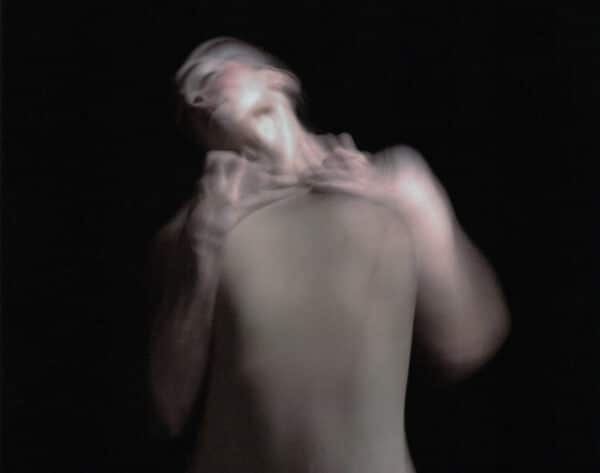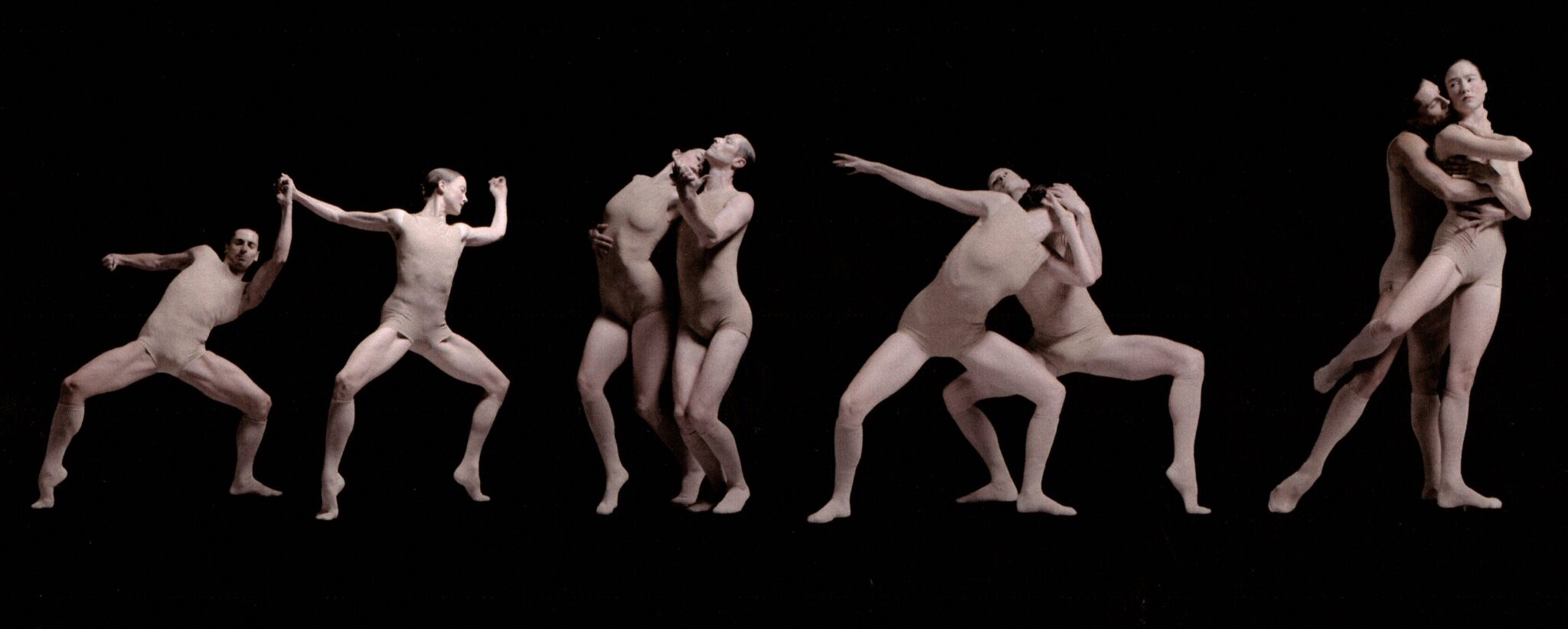

With Delay the Sadness, Sharon Eyal presents a deeply personal work, where loss and grief are transformed into a vital force. A precise composition drives this intense collective choreography, where fragility and strength intertwine in a ballet propelled by a chaos of emotions that punctuate every human life.
What was the initial spark behind the creation of Delay the Sadness?
My first feeling is never a beginning — it’s something that’s always there. The creation is always rooted in memory and emotion. And of course this piece especially, as I created it for my mother and for all the mothers in the world. For me, creation does not start — it continues. It’s a thread already woven, a pulse already beating.
The title suggests a confrontation with an emotion — the word itself plays an important role in your work. How did you move from a feeling into physical movement? What was this process like?
Emotion is always present— like a machine filled with buttons, and creation becomes finding the right one to press. In this piece, sadness, grief, and optimism are many buttons charged at once.
Because I work in a deeply physical way, everything comes from the body. Movement becomes the language — the place where emotion is translated. I believe in sensations that rise from the physical and then travel into powerful feelings.
We carry everything inside us — the challenge is simply choosing, combining, and allowing it to speak
« At the end of the day, we remain profoundly alone. »
What did going from a personal experience of loss and grief to creating a group piece — processing and expressing emotions collectively — generate for you?
For me, it’s always about the group — about people sharing space, breath, presence. And yet, at the end of the day, we remain profoundly alone.
It’s the collective emotion expressed through the physical body, the way we move together, that brings those deep feelings to the surface.
What happens when sadness is “delayed” rather than confronted or embraced? Did this idea of delay become a choreographic tool — and if so, how?
In this case, I don’t translate the word delayed directly into movement, but into sensations. It’s more total than simply responding to a word.
How did your collaboration with the dancers shape the final piece? What was the process like? Could you give us precise examples of how you work in the studio? Do you use improvisation, or is the movement mostly defined before rehearsals?
The dancers always influence my creation. I work with individuals — especially in my company — and I know them so deeply that I can already imagine the movement on their skins. It’s something that grows between us, over time.
In the studio, the first step always begins from my body. I dance, and the rehearsal director or the dancers film me. From there, the movement is passed on to them.
I work through my improvisation but the physicality is very strict — the movement precise, technical, minimal, intense. And from that clarity, inspiration can expand.
« A ballet that is at once futuristic and oddly old-fashioned, reminiscent of a minuet, a ballroom dance, or an intricate fusion of all these styles —in a deeply physical way. »
Your choreographic language is known for its intense physicality. How does Delay the Sadness continue that? Did you notice shifts or changes in energy brought by the topic and emotions you were working with?
This piece is extremely personal — I’m even singing in it. So when I was improvising and shaping the movement for the dancers, it felt as if something inside my body cracked open, and the creation itself became my way to heal.
I felt like something was broken, and yet had to keep moving through it. With Delay the Sadness I came to face another layer, deeper than before.
It’s rawer, more bleeding than ever.
What feeds your physical and sharp choreography? Contemporary, ballet, Gaga — they are all part of your movement vocabulary. What interests you now? How would you describe this mix of practices that forms your signature?
My style, as you say, combines everything. It’s like mixed feelings — like herbs in a soup.
Not one thing, not two — many. A whole life of experience translated in the body and the love of dance.
I danced ballet, I danced modern — I danced everything. But today I have a strong attraction for ballet. What I love in ballet is the friction, the extremity of the technique, the clarity, the composition.
I combine it with a very human, newborn articulation of emotion. It might be a new mutation! A ballet that is at once futuristic and oddly old-fashioned, reminiscent of a minuet, a ballroom dance, or an intricate fusion of all these styles —in a deeply physical way.
Were you interested in physical concepts like the body’s vulnerability or resilience? Are those parameters present in the piece according to you? If not, what kind of physical elements were a driving force for the piece?
I’m interested in the interplay between strength and fragility, the way one defines the other. I actually don’t describe it so much as strength, but rather as precision. Power, for me, is revealed in fragility—it’s allowing a quiet moment, it’s having the capacity to listen. In the end everything revolves around fragility in a single thread running through the work.
What is the rhythm of the piece like? How would you describe it?
I think the rhythm of this piece is like the ocean—fluid, but also deep and dark. It’s a space you can dive into and in which you can get overwhelmed, almost drowned. It wraps you in layers of texture, both dense and translucent, sticky yet see-through.
« I believe music can transform and heal »
Music is always an important partner in your work. What was the sound design like for this piece, and how did you decide to work with Josef Laimon?
Music is one of my greatest sources of inspiration. It changes my mood, stirs everything inside me—it brings life, and I believe it can transform and heal from within.
Josef is a dear friend and a phenomenal musician. Collaborating with him felt very organic. For the first time in my life, I’m singing in a piece, and I couldn’t have done it without him. My son Charly also sings in the piece, we have a small duet together, which makes it deeply emotional.
The music itself is very sad, but it’s full of unexpected layers and textures. I often tell Josef that it feels more like material than music—I sometimes forget it’s music at all.
The costumes and makeup seem to play on uniformity and singularity at the same time, creating a visual consistency but leaving some room for dancers’ personalities to pop out. How did you work on those contrasts, and what do they represent in the piece?
I love this question. Costumes and makeup, like the choreography, speak of both everybody and nobody, or everybody and one person. There is always this delicate tension between the collective and the individual, and the individuals within the group.
For Delay the Sadness, I created the costumes with my husband and my daughter Noa, who also is our makeup and hair artist. In this piece we looked for contrast between pale and aged tones, freshness and skin tones—a combination of time, memory, and presence. The makeup looks as you could almost touch it. It has a ceramic quality, like a delicate doll that could break apart.
I love the costumes, makeup, and hair in this piece because they carry a deeply personal resonance for me—it reminds me of my mother, and my daughter’s involvement makes it emotional and intimate in a very special way.
What does the piece convey to those watching it? Have you received any feedback from audiences already?
I think, for now, what I’ve seen is a lot of crying, a lot of shock, a lot of happiness, a lot of sadness… just a lot of everything. A lot of love.
Is Delay the Sadness the opening of a new cycle, or a continuation of your previous pieces?
I’m not sure I have creative cycles. But Delay the Sadness definitely opened something very new in me—something transparent. I feel like I exposed another layer of my emotions for this piece. The crack becomes a little deeper here.
What continues to drive you to create in these complicated times? Are dance and choreography a hopeful force for you?
All my life dance has healed me. It brings happiness and honesty. I simply can’t not do it and will continue to create forever and ever.
I also would like to add something about my husband, Gai, who works with me—without him, I couldn’t do anything. He is my biggest inspiration, my greatest support, and… a huge, huge love.
Collected by Marie Pons for La Villette, October 2025
SHARON EYAL danced with the Batsheva Dance Company from 1990 to 2008. Since 2005, she has collaborated with Gai Behar on her creations, and in 2013 they launched an independent international choreographic project, whose repertoire is co-produced with some of the world’s leading dance centers. The trilogy dedicated to love—OCD Love, Love Chapter 2, and Chapter 3: The Brutal Journey of the Heart—contributed to the duo’s global recognition. Among other works, they created choreographies for the Nederlands Dans Theater, the Paris National Opera, and the StaatsBallett Berlin. Their career has been recognized with the FEDORA VAN CLEEF & ARPEL Ballet Prize (2017), the Faust Prize (2018), and the Grand Prize of the Dutch Dance Days (2025).
Permanently settled in France in 2022, they officially founded the Sharon Eyal Dance company (S-E-D). One year later, Sharon Eyal was appointed Officer of the Order of Arts and Letters. Following Into the Hairy in 2023, Delay the Sadness is the second and final creation of this new chapter. The end of 2025 also marks the completion of the residency of Sharon Eyal and S-E-D at the Palais de Tokyo, inaugurating the new program Symbiosis, dedicated to the performing arts. Beyond dance, Sharon Eyal and Gai Behar have over the years developed numerous multidisciplinary projects, exploring fields as varied as fashion—with runway shows for Christian Dior Couture and Maria Grazia Chiuri—music, in collaboration with Jamie xx, Ben UFO, or Koreless via the Young label, as well as visual arts, alongside artist George Rouy, the Hauser & Wirth and Hannah Barry galleries, and designer Es Devlin for Art Basel.
Don’t miss this show