
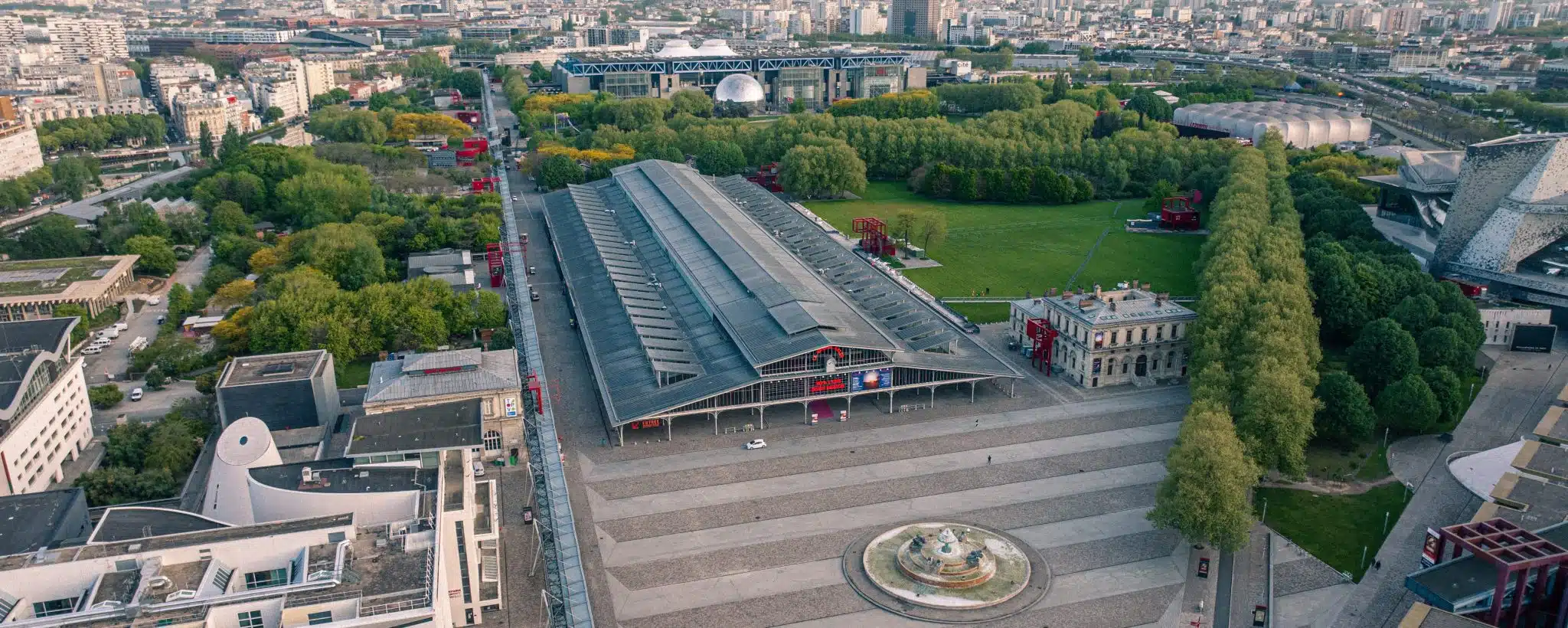

The Parc de la Villette is an example of French expertise in urban redevelopment, as evidenced by its exceptional architectural heritage. It includes the Grande Halle, built in the 19th century, the follies designed by Bernard Tschumi, and the Geode constructed between 1983 and 1986. Additionally, the Philharmonie de Paris by Jean Nouvel, which opened in the park in the 21st century, further enhances its architectural diversity and cultural significance.
Going beyond the traditional park model, Parc de la Villette has embodied for the past 30 years a new landscape approach as an urban cultural park. It serves as a place where cultures and nature intersect, fostering dialogue between arts and society.
The Public Establishment of the Parc and Grande Halle de la Villette (EPPGHV) is responsible for the development and daily management of the buildings and landscaped spaces of the park, as well as the cultural programming of numerous venues.

APSV (La Villette Prevention Association)
Founded in 1986, the La Villette Prevention Association (APSV) embodies the social responsibility of the site’s cultural establishments by carrying out prevention, education and social support initiatives for young people and populations in priority neighbourhoods. To do this, it draws on all the cultural resources of the La Villette site and its economic integration enterprises Villette Emploi.
LEARN MORE
Le Cabaret sauvage
The Cabaret Sauvage is an unusual venue with a varied programme: concerts, live shows, night-time events and open-air performances share the bill at the capital’s most iconic big top. For over 25 years, the Cabaret Sauvage has been celebrating the diversity of contemporary music by welcoming artists from all over the world.
Architect : Boris Zeisser
LEARN MORE
The Cité de la musique – Philharmonie de Paris
The Cité de la Musique – Philharmonie de Paris is a unique musical complex offering the best of musical repertoires in spaces designed to enhance the listening experience. In addition to its particularly rich concert programme, its museum, exhibitions and numerous activities are all invitations to venture into the world of music.
Architects : Christian de Portzamparc (Cité de la musique) and Jean Nouvel (Philharmonie de Paris)
LEARN MORE
The City of science and industry
Created in 1986, the City of Science and Industry is a Universcience venue that serves as a bridge between science, society and technology, and a privileged place of discovery, innovation and education for a diverse audience.
Architect : Adrien Fainsilber
LEARN MORE
Le Conservatoire de Paris
The Paris Conservatoire is a public institution of higher education in the arts. As France’s leading institution for the teaching of music and dance, it provides high-level education and pursues an ambitious policy of creativity, research and outreach to the public. Inaugurated in December 1990, the building is part of the Cité de la Musique project designed by Christian de Portzamparc for the Parc de la Villette.
Architect : Christian de Portzamparc
LEARN MORE
Dimension Parabole
The mission of the Dimension Parabole association is to restore and operate the Villette radio telescope for public astronomy demonstrations and experimentation with space telecommunications techniques.Located near the Géode, this radio telescope is one of the largest operational non-professional instruments in France.
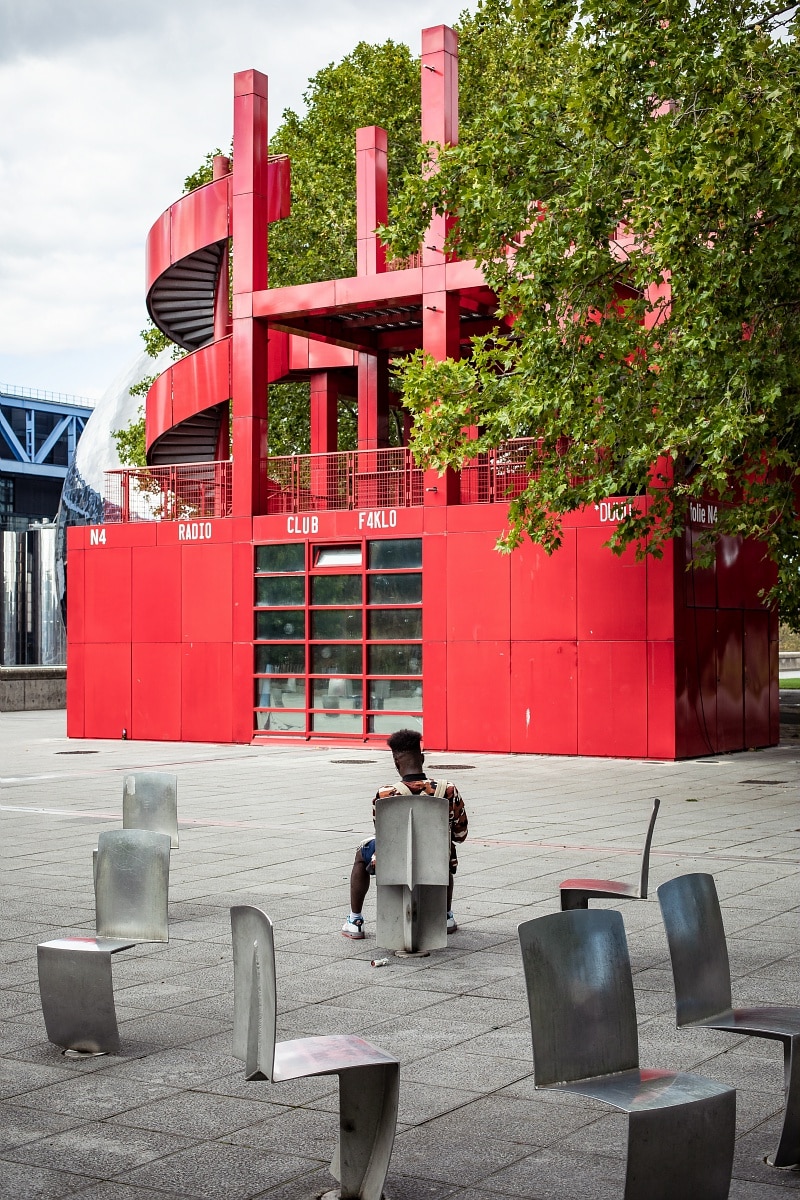
*Duuu Radio
Dedicated to radio art, *Duuu showcases voices from the contemporary scene and forges links between visual arts, sound, writing and performance. From its professional production studio or on the forecourt of the folly N4, it offers a public programme of broadcasts and events (concerts, readings, screenings, meetings, etc.).

La Géode
A true evocation of the Earth, this shimmering sphere designed by Adrien Fainsilber and Gérard Chamayou is made up of 6,433 polished stainless steel triangles and measures 36 metres in diameter. It houses a cinema with a 996 m² hemispherical screen coupled with an IMAX 6.0 sound system, modernised by Pathé and dedicated to a diverse programme of scientific and nature documentaries, major films, shows and more.
LEARN MORE
Le Hall de la chanson
Formerly the canteen for butchers at La Villette (1867) and then the International French Language Theatre (1992), this building, decorated by François Seigneur, has been the National Centre for Song Heritage since 2013. It creates, produces and presents its shows and EAC activities there. In 2018, it incorporated the TÉC, its own higher education institution.
LEARN MORE
Jardin 21
Located on the banks of the Ourcq Canal, this garden was born from the combination of an urban vegetable garden and a Berlin open-air space. With over 1,600 m² of outdoor space, Jardin21 welcomes you in spring and summer with its locally sourced dishes, botanical workshops, cultural programme, dance floor under the sun and lively open-air cafés after dark.
LEARN MORE
Karma Paris – La Villette
Opened by the FFME (French Mountain and Climbing Federation), the new Karma Paris La Villette climbing centre offers three Olympic climbing disciplines : bouldering, lead climbing and speed climbing, with between 65 and 70 rope lines spread across walls reaching heights of up to 12 metres. A fast food area completes the experience.
Opening hours:
– Monday: 2:00 p.m. – 11:00 p.m.
– Tuesday to Saturday: 9:00 a.m. – 11:00 p.m.
– Sunday: 9:00 a.m. – 10:00 p.m.

Le Théâtre Paris-Villette
In 1972, the Théâtre Paris-Villette was the first cultural institution to set up on the La Villette site. Formerly the Pavillon de la Bourse (1867) during the days of the slaughterhouses and livestock market, this neoclassical building was listed in the supplementary inventory of Historic Monuments in 1979. Since 2013, its management has adopted a policy of supporting creativity in order to encourage new forms of theatre and dance, for the benefit of all audiences and in particular young people (from the age of 2).
LEARN MORE
Kilomètre25
A welcoming 2,200 m² venue, Kilomètre25 offers a multidisciplinary programme at the crossroads of arts and cultures. Open from April to October, Kilomètre25 welcomes international artists and local collectives, mixing several styles ranging from techno to house, hardtechno and trance.
LEARN MORE
Mia Mao
Located in the Halle aux Cuirs, a 3,000 m² space with vaulted ceilings and 7 m high ceilings, the Mia Mao club offers an international electronic music programme supported by a custom-designed sound and lighting system. With its Mia Mao Music platform (label, livestream channel, web radio), the club forms a 360° musical ecosystem.
LEARN MORE
MU Architecture
The folly N5 is dedicated to architecture, landscape and territories. MU brings an ecological and regenerative vision of architecture to the space. In partnership with the CAUE (Council for Architecture, Urban Planning and the Environment) of Paris, MU also promotes architecture and landscape through exhibitions, conferences and teaching.
LEARN MORE
Oasis 21
This cooperative and sustainable third place managed by Citécoop offers workspaces to those involved in ecological, social and civic transition. Located on the top floor of the Halle aux Cuirs, the 1,500 m² site comprises offices, open-plan spaces, meeting rooms and communal areas.
Architect : Camille Behaghel (Atelier 108)
LEARN MORE
Babour Sauvage barge
The little sister of Cabaret Sauvage, the Babour Sauvage barge offers an eclectic programme. In an intimate setting, acoustic concerts, DJ sets, cabarets and other curiosities follow one another throughout the year. Enjoy food and homemade cocktails on board, either on the large terrace by the quay or inside in the hold!
LEARN MORE
Le Baruda – Cinema barge
Welcome to Le Baruda – Péniche Cinéma. Our various evening events give you the opportunity to make and screen films, as well as organise aperitif concerts at the end of the day and DJ nights at the weekend.
LEARN MORE
Poney club – Equestrian centre
Horse riding for all ages and levels. Baby pony riding from age 3, lessons for children, teenagers and adults, leisure and competition activities: group and individual lessons, show jumping, Equifun, hunter… Centre certified by the French Riding School, the Pony Club de France, the Cheval Club de France and Animal Welfare.
LEARN MORE
Le Trabendo
Le Trabendo is a concert venue renowned for bringing artists and audiences together in an intimate setting. Housed in one of the folies, the venue is an integral part of Bernard Tschumi’s architectural work. It was designed in the shape of an ear, an obvious but ambitious parallel for a concert hall. Operated since 2012 by Tsugi magazine and producer Super!, its pioneering programme mixes rock, indie, electro, rap and world music.
LEARN MORE
Tsugi Radio
Since 2015, Tsugi magazine’s web radio station has been offering a unique mix of new music from the electronic, pop, indie and hip hop scenes. In 2019, Tsugi Radio took over the folly L1 and presented programmes, DJs who came to mix live and live music.
LEARN MORE
Villette Makerz
Located in the folly L5 on the banks of the canal, Villette Makerz is a cultural space and collaborative design and manufacturing laboratory – Fablab – for experimenting and sharing knowledge by combining contemporary technologies and traditional craftsmanship. At weekends, the public can enjoy free access to ‘Faire ensemble’ (Making together) and a collaborative artistic programme. During the week, professionals come to train, experiment and manufacture.
LEARN MORE
Zénith Paris – La Villette
Designed by Philippe Chaix and Jean Paul Morel as a venue specially adapted for rock music and, more broadly, popular music, the Zénith was inaugurated in 1984 under the auspices of the Ministry of Culture and Communication. It is the first venue built under the ‘Zénith’ brand, which now has 17 venues in mainland France. It hosts nearly 150 events and more than 700,000 spectators every year.
LEARN MORE